
Audience as Companion: Reflections on Inner and Outer Audiences
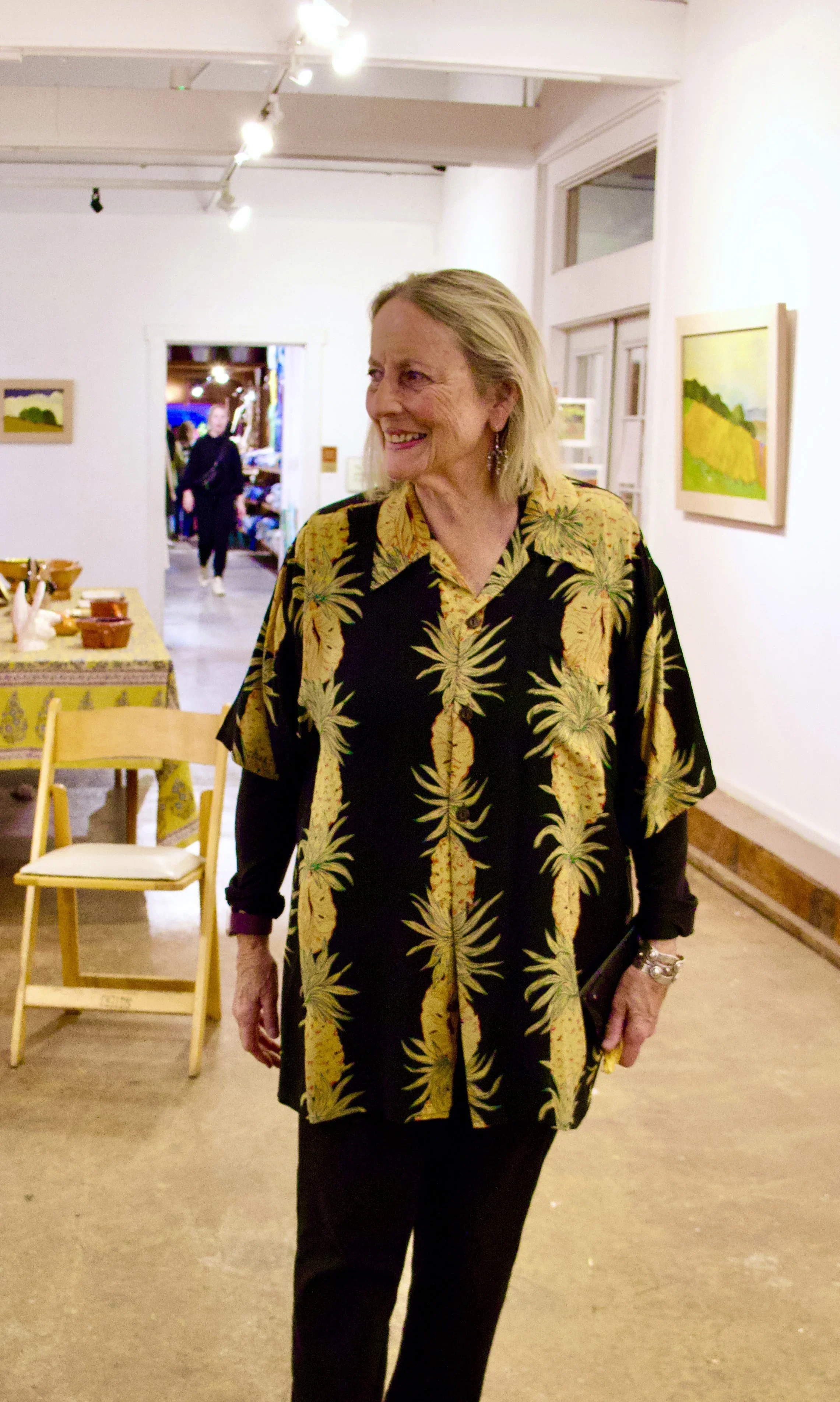
Over the past sixty-plus years, I have exhibited my work in oddball places as well as traditional venues like galleries and museums. With this experience, I’ve gathered volumes of thoughts and opinions about my interactions with audiences and viewers. Lately, I’ve been reflecting on some of the more unconventional settings, and the importance of having my work seen—what kind of connection is made with the viewer, and what happens in that moment of engagement.
This isn’t in chronological order, but rather in the order I remembered some of the ways I’ve exhibited my work. One of my first exhibitions was in Point Reyes Station in 1962. I was 18 years old and asked Tony Morris, who had a garage on Main Street, if I could hang my art there. He agreed, and I set my drawings and paintings on the pool table—the centerpiece of the garage—and nailed a few larger paintings to the wall.
I sold some paintings, but since the drawings were stacked on the pool table, some people assumed they were free and began helping themselves. Since some of those people were friends, it became a delicate situation. I don’t remember exactly how it worked out, but since we remained friends, I suppose it was resolved peacefully.
Many years later, I had a show in the bakery in Tomales, population less than 500, and spent a lot of time brushing flour off my framed pieces. My daughter Kacy helped me hang the show. She had a good sense of humor as well as a knack for hanging artwork. I must say everything looked quite appetizing—art and croissants!
Speaking of food, I also hung my work in a cheese shop in San Francisco. My thinking was that cheese lovers would love my work, since they put so much effort into cultivating their tastes and preferences. I was right, and from that experience I gained several lasting friendships and collectors—some of whom I’m still in touch with today.
I’ve also shown my work at street fairs, in feed barns, and in friends’ homes. Currently, I show every two years or so at Toby’s Feed Barn in Point Reyes Station. Why, you might ask? I’ve known the owner almost all my life, and I honor and respect the gallery he created at the back of his feed store. I’ve had maybe ten shows there. I love arranging the bales of hay into seating areas, and it always smells really good. Can you beat the smell of alfalfa and oats? The occasional mouse shooting around the corners adds to the ambiance, and there’s an old grand piano in the corner, played by whoever feels like it.
In 2018, I spent time at my then-current exhibition at Toby’s talking about art with Prince Charles and Camilla, who were visiting West Marin. It’s well known that Prince Charles is a fervent organic farmer and painter. He seemed to really enjoy himself in the exhibition, and our conversation was lively and thoughtful. Meanwhile, Camilla played with the little black-and-white dog sleeping under the grand piano. Neither of them were stiff or formal. The conversation was warm, pleasant, and memorable. I was reminded that wherever I am, I should be on the lookout for surprise encounters—which can bring happy consequences.
Having an audience made me happy, and the circumstances shaped my thinking and creative process. Each venue attracted its own audience because of its location and character, which I found invaluable. I love attention—even though I consider myself an introvert. Perhaps recognition of my abilities helps spur me on, along with the enjoyment of being with people. All in all, I experienced these innocent encounters as natural and mutually fulfilling. My art is not so much concerned with audience as with connection. I found a lot of joy in the simple pleasure of showing my work and hearing the responses of viewers.
I’ve also gone through periods when I didn’t have much of an audience. Sometimes I had no exhibitions, or wasn’t involved with any community, or simply felt inclined to work entirely on my own.
At those times, the only satisfying and fulfilling audience was myself. Often, the act of drawing and painting felt so natural and complete that the need for other eyes to see my work seemed unnecessary. It was like an interior structure—a felt sense I couldn’t quite name—that felt more natural and grounded than the outside world. This second reality had its own life, and no audience was needed. It was a way to explore touch and feeling without questions or purpose. My own attention and viewpoint were enough. It became an accompaniment to my life, a way to record my existence. Without an outside audience, I was more conscious of what I was doing. I could underline experiences that might have flowed through my life invisibly—without recognition or acknowledgment.
This second reality had its own pulse, and I remain eager to record its existence. It transported me into an intimacy that empathized with the outer world. I could fall in love with the world, and instinctively know and respect its autonomy and beingness. This was an act of devotion for me—one that elevated my spiritual life.
It meant I was portraying something alive and complete, and I didn’t need to intellectualize it. The feelings were profound and enough to carry the weight of my heart. I never really let go of this innocent approach—even though at times it was clouded by teachers, critics, or the habit of comparing myself to others. I had an instinctive response that some viewers intuitively understood. In other words, sophistication and knowledge came second to intuition and a felt interior sense.
This has been a lodestar and cornerstone of both my artistic vision and my spiritual life.