
The Gifts of the Garden
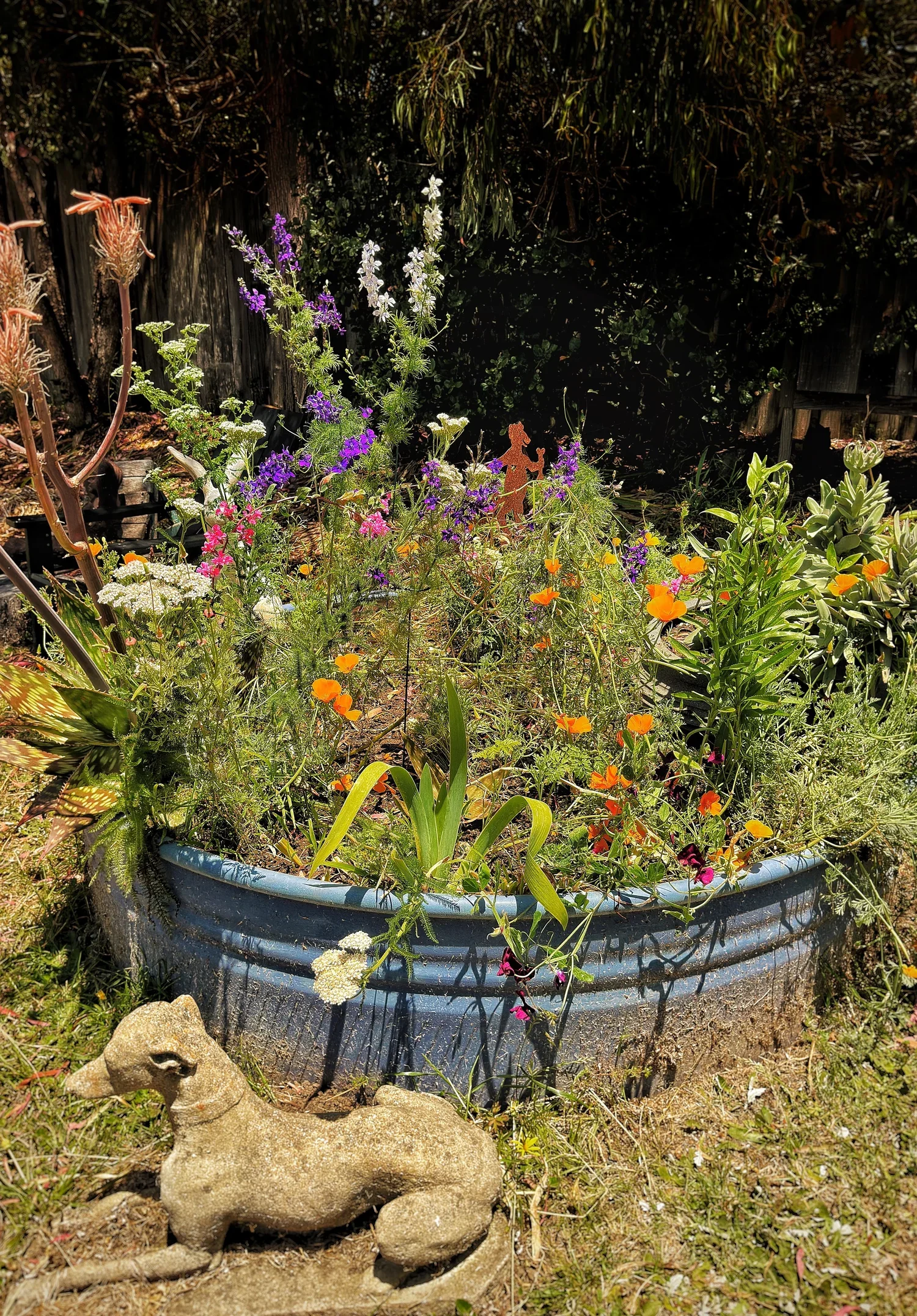
I wrote and read this at my mother Avis’s memorial service in 1996.
It is difficult to describe a life. It is easier to relate the events of a life but the warmth of a spirit is difficult to impart, describe or express. Avis’s garden was such a part of her that I find it the easiest way to talk about her. In describing the gifts of her garden I will also be imparting the depth of her being.
It makes sense that Avis died in May. Her last day on earth was glorious. This year everything bloomed with an unprecedented richness of color and a giant profusion of blossoms. The Cecil Bruner roses had so many blooms the leaves were barely visible. The Belle of Portugal rose climbed fifteen or twenty feet high. Its huge lacy pale pink petals were so translucent the sun could be seen through them.
The red bottle bush was so full of nectar the humming birds were out at night, busily emptying them. The purple and white iris outdid themselves this year. They zigzagged and peered out of every part of the garden. In the wind they bowed and swayed, paying homage to Avis who sat in her chair by the window. She had a daily view, overlooking perhaps supervising, the onset of this glorious spring. In places the ground was carpeted by the petals of wild cherry blossoms, Japanese quince and bridal veil. The day she died, the smell of honey suckle was everywhere. It was the most beautiful day of the year and garden was at its most splendid.
Avis, this last year was no longer able to garden. Yet she made her way around the yard and sat in a chair on the deck in the sun. She rarely complained about aches and pains and didn’t dwell on the fact she could no longer weed or cut bouquets. She accepted old age as a part of the natural order of life. The blooming of the flowers, the coming and going of the birds, the seasonal winds, they, too, were a part of the natural order of things. As she grew older she was a part of that progression and procession of wind, rain, sun, that determines the flow and rhythm of life.
She enjoyed the fruits, flowers of her yard and tended to them in a simple straight forward manner. She wanted her garden to be wild, untamed, uncultivated looking. Weeds and flowers often had equal opportunities to multiply. In fact, many trees and plants were planted by the birds and grew in unlikely places, all respected by her. They existed naturally and spontaneously with a chance to grow without fear of being removed.
She didn’t want fences to inhibit wild animals, cats, dogs, or children from enjoying the little paths that wound through the garden. As a result, the subtle interconnectedness that is the daily business of country life unfolded in its own timely space. Such as the way that she was able to bring the world into her daily life.
She never drove a car, was content not to travel, was not greedy for material possessions or great strivings. She preferred the slow unfolding that occurred in her own world and always found it interesting. She loved walking to the post office, going to the store, exchanging hellos and greetings with people and having lunch with her dear friends.
Domestic life fulfilled her totally. Some of my fondest memories of Avis when I was a child are of her hanging clothes on the clothes line, the spring wind lifting them up snapping them playfully. I remember her shelling peas on the back steps, cutting Toyon berries at Christmas, gathering eggs, talking with neighbors.
In a very simple and direct way she responded to other people’s needs. I remember older people in the neighborhood that she consistently did things for. Sometimes it was a visit, sometimes an errand, but whatever she did for people was done easily and kindly. She didn’t have any ego about helping people because she honestly enjoyed and liked them. She taught me that all ages of life were important and had special needs. Being with people, listening to them, to her was as important as doing something for them. She wore her commitments to others lightly, without the need for fanfare or approval from the world.
This was also true of all of her volunteer and church work. It wasn’t an “issue” but rather simply part of her life. She loved the church and in particular enjoyed teaching Sunday School and the After School program. Putting flowers in the church was, for many years a natural extension of her garden to the outside world. She was dedicated and committed to the church as an act of daily faith.
In the late 60’s and 70’s she was interested and befriended many of the “newcomers” and I made many friends through her introductions. Many of these people are in my life today. She attended and supported the numerous poetry readings, plays, events that the community began to provide. She enjoyed a book group and weekly book discussions.
She was always welcoming and supportive to the friends I brought to Point Reyes from New York. No matter how odd or peculiar they were in appearance or manner she encouraged their talents and art. Even when she didn’t quite understand their work she would enthusiastically support the person who did it. She encouraged my art by giving me the space to do it. Space, as any artist knows, is a prime ingredient of creativity.
The gifts of Avis’s garden will always be with me. Her unselfish conscious gentle nature will enrich me for the rest of my life, helping me to tend to the gifts of my own garden.
I will close with a poem by Mary Oliver:
Roses
I wouldn’t mind being
a rose in a field
of roses.
Fear has not yet occurred
to them-nor ambition.
Reason they have not yet
thought of…
Neither do they wonder
how long they must
be a rose-
and then what,
or any other foolish
question.